UPDATE, Dec. 21, 2013: Just got word that Mitzi has been adopted. Boomer is still waiting but is safe at the foster home for as long as needed. Unfortunately, the news isn't good for Panda Bear. She had to be euthanized the other day after one hip was injured when she fell and the femur head ripped through the hip bone and damaged internal tissues. Surgery to repair this is prohibitively expensive for the foster family, and due to the extreme pain and uncertainty of the outcome of any surgery, it was decided to end her suffering. Condolences to all who knew and loved her, and to the foster family for their devotion to her well being.
These three dogs are living in a foster home for now and are safe, but they can't stay there forever, sadly. The foster family loves them very much but they must keep their rescues moving so they can have room for the next dog or cat that desperately needs a home.
This is Panda Bear, a Great Dane mix. She's only one year old and has just been spayed and vaccinated. She's healthy, housebroken, and kennel-trained, but she has a problem: her hip sockets didn't form correctly. She has trouble walking and is in pain if she tries to run and play. So she gets depressed and lays down a lot. The veterinarians feel surgery to remove the ball joints will help her to adapt as she recovers and the joints may "remodel" so she can live a more normal life. She needs a calm, more or less quiet, home with patient caregivers. She would prefer a playful, noisy house, with kids, but her condition wouldn't allow her to survive it.
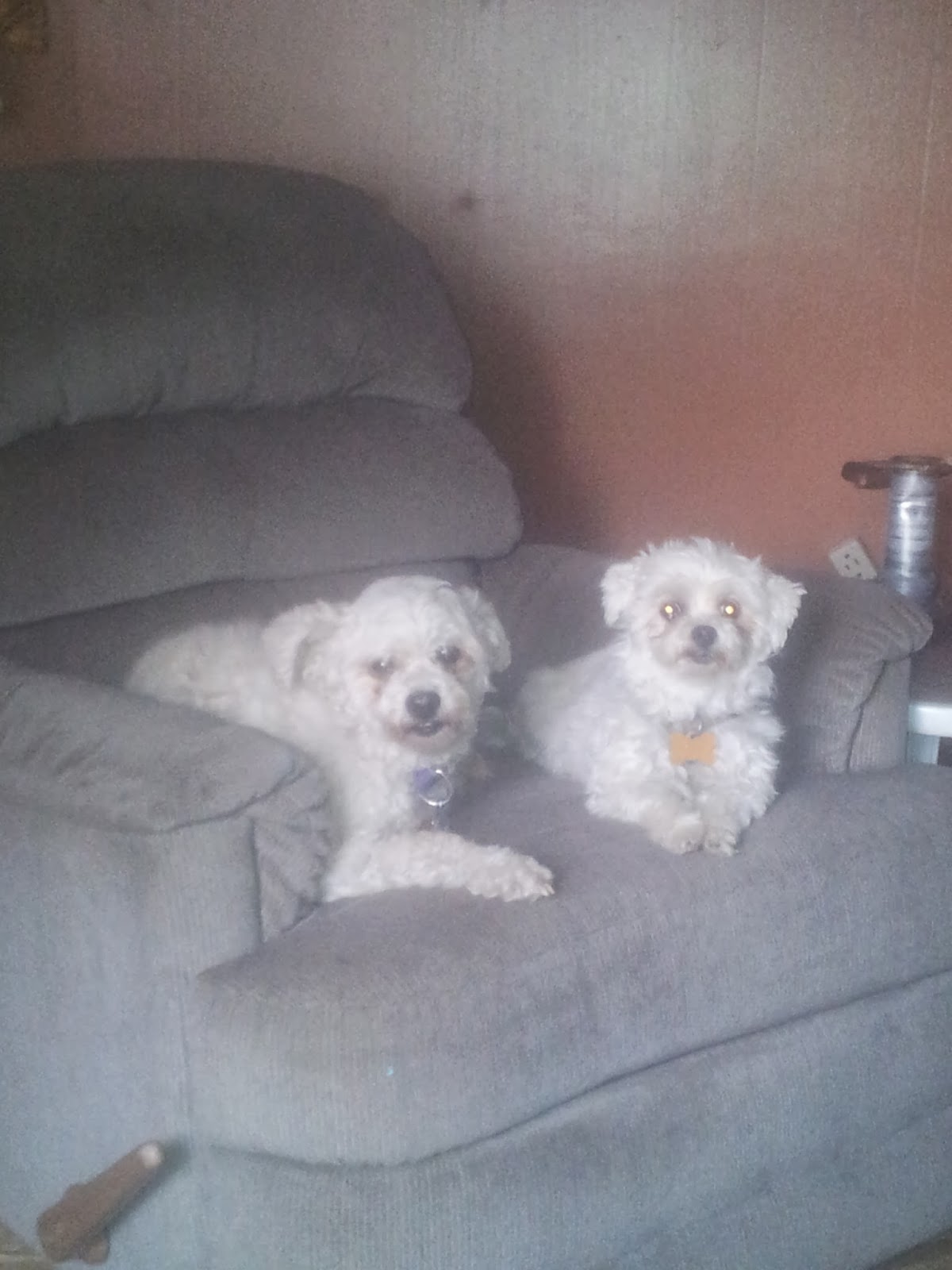
And these two little white dogs on the right are Boomer and Mitzi. They have not been apart from each other since they met, so it's pretty important for them to be adopted together. They are not from the same litter or anything, but they are inseparably in love. Mitzi is 8 years old, spayed, vaccinated, up to date on all shots, housebroken, etc. Boomer is neutered and up to date as well. Mitzi is a miniature Maltese and Boomer is a Poodle/Maltese mix. He's only slightly larger.
All of these dogs are available for adoption to the right families. Send any inquiries by email to:
trainyourowndog@live.com.
Cutting through the complex to find simple ways to help your dog be the kind of companion you will cherish.
Sunday, December 15, 2013
Saturday, October 20, 2012
Is it Halloween Again Already?
It seems like only yesterday, but here it is, another year gone by and we're shopping for costumes for the kids, and maybe even for the dogs, too.
Remember these few pointers for a successful Halloween:
Enjoy your Halloween!
Remember these few pointers for a successful Halloween:
- Costumes should be comfortable and loose enough to allow movement without getting tangled.
- Many candies are toxic for dogs and should be kept out of reach, especially chocolate.
- Electric cords and candles should be placed safely to avoid tripping on them and causing a fire.
- Keep your dog inside all evening. It's potentially hazardous outside, so just avoid it.
- Even a normally calm dog could get agitated or excited when the front door opens to strangers every few moments, so either keep him on a leash or in another room until the Trick-or-Treating is over.
- That said, don't just leave him alone in a back bedroom. He can hear the commotion out front and may go bananas by himself. It might work better to crate him where he can see you.
- If your dog is still a puppy, keep him with you, leashed, and include him in your activities so he can learn new things.
Enjoy your Halloween!
Saturday, August 4, 2012
Disturbing List of Dog Heatstroke Deaths
Should you call the police when you see a dog locked in a car on a hot day?
Well, yes. But who should you call when it IS the police?
Follow these links to stories about dogs who died this year as a result of being left in a vehicle in hot weather. There are far more dog deaths than these, but there is something unique about this list. They are all police dogs who were left in a hot patrol car.
(This list is current as of today, but most news agencies remove stories after a certain length of time, so some of these may expire over time.)
http://www.topix.com/forum/news/obits/T3AOFVVPJOAKHCMAB
http://fetch6.arsalon.net/blogs/nosetotheground/General/tragic_trend_of_police_dogs
http://www.i4u.com/2012/07/chevrolet-tahoe/texas-die-suv-police-hot-dogs-2
http://www.examiner.com/article/two-bexter-county-sheriff-s-k-9-s-perish-after-forgotten-patrol-car-overnight
http://www.topix.com/forum/city/lake-city-fl/T4P9ARGMMHIP97BTT
http://www.topix.com/forum/city/fort-lauderdale-fl/T4TS6IK22GSF3FT8Q
http://www.topix.com/forum/phoenix/T3IE05IUCV1KC77I0
http://www.topix.com/forum/news/obits/T3AOFVVPJOAKHCMAB
http://www.topix.com/forum/city/bartow-fl/TDE299FO5DRIOU65T
http://forums.prosportsdaily.com/showthread.php?t=741084
http://www.nctimes.com/news/local/oceanside/article_6d05ff25-3b9e-50f1-bdb1-1a5bae7ae862.html#.UBQ5UyLR9jI.email
http://fox8.com/2012/07/27/police-dogs-die-after-being-left-in-hot-patrol-car/
Well, yes. But who should you call when it IS the police?
Follow these links to stories about dogs who died this year as a result of being left in a vehicle in hot weather. There are far more dog deaths than these, but there is something unique about this list. They are all police dogs who were left in a hot patrol car.
(This list is current as of today, but most news agencies remove stories after a certain length of time, so some of these may expire over time.)
http://www.topix.com/forum/news/obits/T3AOFVVPJOAKHCMAB
http://fetch6.arsalon.net/blogs/nosetotheground/General/tragic_trend_of_police_dogs
http://www.i4u.com/2012/07/chevrolet-tahoe/texas-die-suv-police-hot-dogs-2
http://www.examiner.com/article/two-bexter-county-sheriff-s-k-9-s-perish-after-forgotten-patrol-car-overnight
http://www.topix.com/forum/city/lake-city-fl/T4P9ARGMMHIP97BTT
http://www.topix.com/forum/city/fort-lauderdale-fl/T4TS6IK22GSF3FT8Q
http://www.topix.com/forum/phoenix/T3IE05IUCV1KC77I0
http://www.topix.com/forum/news/obits/T3AOFVVPJOAKHCMAB
http://www.topix.com/forum/city/bartow-fl/TDE299FO5DRIOU65T
http://forums.prosportsdaily.com/showthread.php?t=741084
http://www.nctimes.com/news/local/oceanside/article_6d05ff25-3b9e-50f1-bdb1-1a5bae7ae862.html#.UBQ5UyLR9jI.email
http://fox8.com/2012/07/27/police-dogs-die-after-being-left-in-hot-patrol-car/
Tuesday, December 20, 2011
Holiday Precautions For Pets
With the holidays here, a lot of homes are decorated with all sorts of glittery and bright colored things. Some items can be toxic, such as poinsettia plants, holly, and other materials used in creating decorations. Wreaths, for example, can be made from artificial greens or from real ones. Table centerpieces may include toxic plant matter as well.
If you have a tree in the house, all the ornaments hanging on it may catch anyone's attention and imagination, including kids, cats, and the dog! Some pets are very well behaved and can be taught to leave them alone, but don't count on it when you aren't present.
Then, as the end of the year approaches, more parties are planned, maybe at your house. There might be food items that pets should not get into, including beverages that include alcohol.
And then there might be fireworks in your neighborhood on New Year's Eve. Just remember how this worked for your dog over the Fourth of July and take the same precautions to prevent anxiety from loud noises and a lot of activity in the household.
You may be celebrating, but remember to include your dog's best interests, too.
If you have a tree in the house, all the ornaments hanging on it may catch anyone's attention and imagination, including kids, cats, and the dog! Some pets are very well behaved and can be taught to leave them alone, but don't count on it when you aren't present.
Then, as the end of the year approaches, more parties are planned, maybe at your house. There might be food items that pets should not get into, including beverages that include alcohol.
And then there might be fireworks in your neighborhood on New Year's Eve. Just remember how this worked for your dog over the Fourth of July and take the same precautions to prevent anxiety from loud noises and a lot of activity in the household.
You may be celebrating, but remember to include your dog's best interests, too.
Friday, October 28, 2011
Halloween Costumes For Dogs?
Every year we have fun dressing the kids up for Halloween, but what if you don't have kids? Or what if the kids want to take the family dog with them for Trick-or-Treat? More people now are even answering their doors in costume and like to include the family dog for that, too.
Should your dog wear a costume?
We've seen some really weird ones, some really funny ones, and some that probably should not be worn by anyone, even a pet rock.
Just as with the children, a costume should be comfortable, safe and practical. If it hurts, annoys or restricts your dog's movement, it probably is not the right outfit. It should be loose enough to allow normal movement as well as "breathing room." Too tight, and it could get too hot as well.
Remember, your dog doesn't know what Halloween is and may be very stressed out about the extra activity and noise. However, if your dog has been in your family long enough, he may be happy about the extra attention he gets, and is probably motivated to do whatever pleases his owner. Some dogs may feel better if allowed to sit out the festivities in a quiet bedroom, while others seem to enjoy the extra petting and attention.
Just be in tune with your dog's needs and Trick or Treat night should go very well.
Should your dog wear a costume?
We've seen some really weird ones, some really funny ones, and some that probably should not be worn by anyone, even a pet rock.
Just as with the children, a costume should be comfortable, safe and practical. If it hurts, annoys or restricts your dog's movement, it probably is not the right outfit. It should be loose enough to allow normal movement as well as "breathing room." Too tight, and it could get too hot as well.
Remember, your dog doesn't know what Halloween is and may be very stressed out about the extra activity and noise. However, if your dog has been in your family long enough, he may be happy about the extra attention he gets, and is probably motivated to do whatever pleases his owner. Some dogs may feel better if allowed to sit out the festivities in a quiet bedroom, while others seem to enjoy the extra petting and attention.
Just be in tune with your dog's needs and Trick or Treat night should go very well.
Labels:
Costume,
Dog,
Halloween,
Pet,
trick or treat
Wednesday, September 14, 2011
Time to Say Good-bye to a Swell Dog
It's always a sad thing to have to send a loved pet to the "other side," but sometimes it's the kindest thing to do if they are suffering.
Jager, our beagle/lab mix, was almost 16 years old and had had a good life here on our farm for the last four years. He was a rescue dog and had lived a varied life. But his happiest times were here, chasing rabbits, sniffing all the animal trails, playing with the other dogs, and just sunning himself wherever and whenever he wanted to.
So when he developed a malignant tumor on his face, we were all terribly disappointed that he wouldn't be here very much longer. Treatment for his condition, provisionally diagnosed as a fibrosarcoma, would be over-the-top expensive, with no assurances of a good outcome. In fact, the prognosis included the very real possibility that he might not survive surgery.
Chemo and radiation are extremely expensive, too, with the same lack of promises.
So we let him enjoy his last summer here with us, doing as he pleased. We may have petted him a little more, or talked to him more often (though he was deaf already), and provided more of his favorite foods and treats.
Then the day came. It was not a choice anymore. It had become a necessity. He needed to be helped out of this life, to be freed from the pain and disabilities that seemed to be piling up faster now. See, he was having strokes now, too, and some days he was unable to walk normally. He would recover from these strokes and resume the ability to run again, but he was never as energetic and strong as he had been.
Now it was time.... and we were lucky to find the perfect veterinarian to do it. She and her assistant and I lovingly circled around him as he lay on the treatment table and hugged and petted him till he thought he had already gone to heaven!
Then the vet gently and painlessly inserted the final needle, and Jager fell asleep very quickly, but with love all around him. And I think he knew it.
Jager, our beagle/lab mix, was almost 16 years old and had had a good life here on our farm for the last four years. He was a rescue dog and had lived a varied life. But his happiest times were here, chasing rabbits, sniffing all the animal trails, playing with the other dogs, and just sunning himself wherever and whenever he wanted to.
So when he developed a malignant tumor on his face, we were all terribly disappointed that he wouldn't be here very much longer. Treatment for his condition, provisionally diagnosed as a fibrosarcoma, would be over-the-top expensive, with no assurances of a good outcome. In fact, the prognosis included the very real possibility that he might not survive surgery.
Chemo and radiation are extremely expensive, too, with the same lack of promises.
So we let him enjoy his last summer here with us, doing as he pleased. We may have petted him a little more, or talked to him more often (though he was deaf already), and provided more of his favorite foods and treats.
Then the day came. It was not a choice anymore. It had become a necessity. He needed to be helped out of this life, to be freed from the pain and disabilities that seemed to be piling up faster now. See, he was having strokes now, too, and some days he was unable to walk normally. He would recover from these strokes and resume the ability to run again, but he was never as energetic and strong as he had been.
Now it was time.... and we were lucky to find the perfect veterinarian to do it. She and her assistant and I lovingly circled around him as he lay on the treatment table and hugged and petted him till he thought he had already gone to heaven!
Then the vet gently and painlessly inserted the final needle, and Jager fell asleep very quickly, but with love all around him. And I think he knew it.
Labels:
beagle,
Cancer,
Dog,
euthanasia,
Fibrosarcoma,
Health
Saturday, July 23, 2011
How Are You Handling "Dog Days of Summer" Heat?
Are the Dog Days of Summer getting you down? How about your dog? If the heat bothers you, chances are good it's bothering your beloved dog, too. When we hear about people dying during hot weather, you can be sure there are a lot of dogs dying, too, but we don't hear about it on the news.
How can you help your dog make it through this intense summer? Here are some tips to keep your dog alive:
1. Keep the dog inside your house, especially during the heat of the day. Provide a cool spot in your home if you don't have air conditioning, such as a room with linoleum rather than carpeting. Even a "shady spot" outside may not provide enough cooling for a dog.
2. Be sure there is always clean, cool water...always!
3. Never leave your dog inside a car...not even for "just a minute." It can literally become an oven in there, within just a few moments. If you see a dog inside someone else's car, and you can't get hold of the owner (or if they refuse to do anything) call the police. It could mean the difference between life and death.
4. Help your dog cool off with frozen treats, such as a frozen Kong toy with peanut butter in it, or simply put ice cubes into his water bowl. You can also wet a bandana to wrap around his neck. But it will need to be wetted frequently if the heat dries it out too fast.
5. If your dog shows signs of heat stroke or exhaustion, run, don't walk, to the veterinarian.
Signs of heat stroke may include anxiety, rapid panting, excessive drooling and weakness. The gums may be bright red in the early stages, but if he goes into shock, they will become pale.
If he's outside, just pour cool water over the back of the head, then keep his head and belly areas cool on your way to the vet's office. Frozen cold packs are good, if you have any. If he has collapsed, he will need special medical care to make it.
How can you help your dog make it through this intense summer? Here are some tips to keep your dog alive:
1. Keep the dog inside your house, especially during the heat of the day. Provide a cool spot in your home if you don't have air conditioning, such as a room with linoleum rather than carpeting. Even a "shady spot" outside may not provide enough cooling for a dog.
2. Be sure there is always clean, cool water...always!
3. Never leave your dog inside a car...not even for "just a minute." It can literally become an oven in there, within just a few moments. If you see a dog inside someone else's car, and you can't get hold of the owner (or if they refuse to do anything) call the police. It could mean the difference between life and death.
4. Help your dog cool off with frozen treats, such as a frozen Kong toy with peanut butter in it, or simply put ice cubes into his water bowl. You can also wet a bandana to wrap around his neck. But it will need to be wetted frequently if the heat dries it out too fast.
5. If your dog shows signs of heat stroke or exhaustion, run, don't walk, to the veterinarian.
Signs of heat stroke may include anxiety, rapid panting, excessive drooling and weakness. The gums may be bright red in the early stages, but if he goes into shock, they will become pale.
If he's outside, just pour cool water over the back of the head, then keep his head and belly areas cool on your way to the vet's office. Frozen cold packs are good, if you have any. If he has collapsed, he will need special medical care to make it.
Wednesday, June 15, 2011
It's Time to Think About 4th of July Pet Safety Again!
Here are some tips to help your dog, as well as you and your guests, have a happy Fourth of July:
1. If your dog is the nervous type, you might want to keep him inside the house, possibly in his own room, during those moments of greatest stimulation, such as fireworks or strange people in the house or yard, and give him something to do... a toy or a treat... and a comforting place to lie down, such as his own dog bed or crate.
2. Leave the TV or radio on as background noise to help alleviate any nervousness from unfamiliar or loud noises.
3. If your dog is more social and wants to be outside with you, as during a backyard barbecue, be sure he is supervised or leashed. You don't want him to run away if the hustle and bustle are unnerving to him.
4. If he does get out and runs away, it will help to have an ID tag on his collar so he can be safely returned.
5. To help everyone have a positive experience, you may wish to let your guests give Fido a treat when they arrive. If he is on a controlled diet, perhaps a good head rub will be enough. Otherwise, put the dog in his own space until things have settled down.
6. Be careful your guests aren't slipping him tasty scraps from their own plates, either. Explain to them that certain items could be toxic or dangerous, such as chicken or steak bones, chocolate, grapes, onions, etc.
7. You can help your dog achieve a more relaxed mental state by taking him for a walk before your party begins.
If you have more than one dog, it can be more challenging, but the same tips apply. If everyone present is known to the dog(s), it will be less of a problem for everyone, too.
Have a happy and safe Fourth of July!
1. If your dog is the nervous type, you might want to keep him inside the house, possibly in his own room, during those moments of greatest stimulation, such as fireworks or strange people in the house or yard, and give him something to do... a toy or a treat... and a comforting place to lie down, such as his own dog bed or crate.
2. Leave the TV or radio on as background noise to help alleviate any nervousness from unfamiliar or loud noises.
3. If your dog is more social and wants to be outside with you, as during a backyard barbecue, be sure he is supervised or leashed. You don't want him to run away if the hustle and bustle are unnerving to him.
4. If he does get out and runs away, it will help to have an ID tag on his collar so he can be safely returned.
5. To help everyone have a positive experience, you may wish to let your guests give Fido a treat when they arrive. If he is on a controlled diet, perhaps a good head rub will be enough. Otherwise, put the dog in his own space until things have settled down.
6. Be careful your guests aren't slipping him tasty scraps from their own plates, either. Explain to them that certain items could be toxic or dangerous, such as chicken or steak bones, chocolate, grapes, onions, etc.
7. You can help your dog achieve a more relaxed mental state by taking him for a walk before your party begins.
If you have more than one dog, it can be more challenging, but the same tips apply. If everyone present is known to the dog(s), it will be less of a problem for everyone, too.
Have a happy and safe Fourth of July!
Tuesday, February 16, 2010
Adopt Me? Gal Friday Looking for Special Family!
This dog is truly something special, as they all are, but Gal Friday is the youngest dog we have here right now, at just under one year (we think) and really should be part of an active family.
A high energy dog, she would be perfect for a growing family that ideally has active children who would love to play with her.
We figured she was abandoned, but advertised her as a lost dog anyway. And sure enough, no one ever called. So now we would like to help her find her new, furever home.
If you're interested in this special girl, please contact us at our rescue site, www.hipaws.com.
A high energy dog, she would be perfect for a growing family that ideally has active children who would love to play with her.
We figured she was abandoned, but advertised her as a lost dog anyway. And sure enough, no one ever called. So now we would like to help her find her new, furever home.
If you're interested in this special girl, please contact us at our rescue site, www.hipaws.com.
Labels:
border collie,
dog adoption,
dog rescue
Saturday, February 6, 2010
Our Gal Friday
We named this one Gal Friday because she came to us yesterday, on a Friday. And she is the sweetest dog! She's very smart and knows a few commands, but her youthful exuberance makes her want to play all the time.
She appears to have been abandoned by the side of the highway, as she was "prairie dogging" (standing up to look into cars as they passed by) and test-darting up to cars that looked familiar, apparently looking for her humans.
When we pulled over, she came right to us and jumped eagerly into our van, as if to say, "Finally! My ride is here!"
The first thing we did back home was to leash her so she wouldn't run off, but it was supper time, and she's very thin, so we "did supper." We have a routine, and she learned it immediately.

Each dog is required to SIT by their bowl and then they get their portion. She was last on the list, but by then, she knew what to do!
At this time, she is being advertised as a lost dog, just in case she was NOT abandoned and her owners are looking for her.
She appears to have been abandoned by the side of the highway, as she was "prairie dogging" (standing up to look into cars as they passed by) and test-darting up to cars that looked familiar, apparently looking for her humans.
When we pulled over, she came right to us and jumped eagerly into our van, as if to say, "Finally! My ride is here!"
The first thing we did back home was to leash her so she wouldn't run off, but it was supper time, and she's very thin, so we "did supper." We have a routine, and she learned it immediately.
Each dog is required to SIT by their bowl and then they get their portion. She was last on the list, but by then, she knew what to do!
At this time, she is being advertised as a lost dog, just in case she was NOT abandoned and her owners are looking for her.
Wednesday, December 2, 2009
Teaching My Tripod Dog to Use a Wheel Cart
Babe is my special dog and deserves nothing but the best. After losing her left rear leg as a puppy, enduring a neglectful beginning to her life, she is now about 6 years old and is the smartest, most obedient dog I've ever had. As a Rottweiler mix, she makes a great watch dog.
But as she grows older, the remaining rear leg has been taking all the weight and is now suffering some breakdown of the joint cartilages. We have her on natural joint care supplements, and it helps, but continued stress makes it difficult to see much progress. That's why we wanted to get her some physical help to allow the good leg to recover from the stress of having to do all the work. These dogs are prone to joint problems anyway, so losing a leg just put her at greater risk.
So we appealed to others for help, and through generous donations, we finally were able to obtain her "doggie wheel chair," or, Wheel Cart. It's a DwaneCart and is one of the most lightweight dog vehicles available.
Here she is on her first day, "trying it on:"

Today was her third day of training to learn how to walk in it, and to tweak the settings so it's most comfortable. Once she has the walking down, she will no doubt figure out she can also run!
But as she grows older, the remaining rear leg has been taking all the weight and is now suffering some breakdown of the joint cartilages. We have her on natural joint care supplements, and it helps, but continued stress makes it difficult to see much progress. That's why we wanted to get her some physical help to allow the good leg to recover from the stress of having to do all the work. These dogs are prone to joint problems anyway, so losing a leg just put her at greater risk.
So we appealed to others for help, and through generous donations, we finally were able to obtain her "doggie wheel chair," or, Wheel Cart. It's a DwaneCart and is one of the most lightweight dog vehicles available.
Here she is on her first day, "trying it on:"
Today was her third day of training to learn how to walk in it, and to tweak the settings so it's most comfortable. Once she has the walking down, she will no doubt figure out she can also run!
Sunday, August 30, 2009
5 Ways to Stop a Dog Biting
By Michael Marsden
If your dog won’t stop biting, it can be much more than a frustrating habit. A biting dog can become a huge problem and a liability. If your dog is still a puppy, you know that part of a puppy’s nature is to nip during play. Although puppies may nip and bite gently during play, you must train him not to do so, to avoid potentially larger issues when the dog is full grown. A grown dog that has not been trained to stop biting will likely use its mouth during rough play and end up hurting someone.
So, how to you stop your dog from biting? There are different techniques that you can use to train your puppy to stop biting. You can also use these techniques on your adult dog. Here are five effective ways to stop a dog from biting.
1 – Communication
Communication is a key element in learning for dogs just as it is with humans. When it comes time to train your dog to stop biting, communicate to your dog in its own language. Dogs understand more tone of voice rather than the meaning of the words you say. When the dog bites during play, instead of using a shout or angry voice, try yelping. The yelping is understood as a painful response and will encourage your dog to refrain from biting.
When you communicate to your dog using the yelp, a high-pitched “ouch” will do the trick. When you use this technique, be sure to stop all play immediately and turn your back on the dog. Tone and body language are important to a dog. The dog will eventually come around to you and when he does, reprimand him in a firm tone with a command such as “bad dog” or “no bite” and he will quickly get the idea.
2 – Divert Attention
Another way to stop your dog from biting is to divert his attention from biting you to something that he can chew on, like a toy. By replacing your flesh with a chew toy each time the dog turns to inappropriate biting, he will get the idea that your limbs are not meant for biting. Remember to quickly provide the chew toy if your dog resorts to biting during play again to reinforce the habit.
3 – Positive Reinforcement
A sneaky yet effective way of training your dog to stop biting is positive reinforcement. Positive reinforcement is a training technique that rewards good behavior with something positive. An example of positive reinforcement with a biting dog is to give him wonderful praise during play when he does not bite. The praise could be a pat on the head, a belly rub, a treat, or extra attention. Positive reinforcement is a great way to show your dog the type of behavior that you prefer.
4 – Tap the Nose
If your dog begins to bite or nip, quickly tell him to sit. Once he is seated, take your index finger, hold it in front of his nose, and then tap him on the nose as you say “bad dog” in a stern voice. Just remember, the tap itself is not the punishment, so it should not be particularly strong. It is just meant as a startling element to encourage him to stop the bad behavior. Don’t scream; just use a stern tone, which he will understand. Eventually, your dog will come to understand the raising of an index finger as an indication to stop a behavior.
5 – Avoid Biting and Nipping Games
A good way to stop a dog from biting is to avoid biting and nipping games in the first place. If you don’t encourage these types of games from the get-go, the dog will not be prone to biting and nipping at inopportune times. For example, a chasing game, while it may be exciting and provide plenty of exercise, will likely encourage your dog that you are prey. This is where his nipping and biting instincts will kick in.
Tug-of-War is a game that should also be avoided when playing with your dog. It will encourage him to think that humans are his equal and may promote biting as well. He won’t mean any harm with the biting, but he will want to win, so he will likely nip at your hands to make you lose grip on the toy. Replace Tug-of-War with fetch and retrieval games, and teach him the “drop and release” commands so that your authority is never questioned.
In Conclusion
Biting during play can quickly evolve into a serious problem, which is why consistency is a key way to stop this from happening. It is important that you stop the biting behavior as soon as it starts, and discipline for the bad behavior while reinforcing the good. Remember, dogs do not understand the meaning of “sometimes” so be sure to consistently train the dog until he knows that biting is never allowed.
About the Author:
If you want to learn more about Dog Obedience Training then visit: DogObedienceShortcuts.com – where you will learn about training specific dog breeds and curing common dog problems like getting your dog to stop biting.
Article Source: ArticlesBase.com – 5 Ways to Stop a Dog Biting
If your dog won’t stop biting, it can be much more than a frustrating habit. A biting dog can become a huge problem and a liability. If your dog is still a puppy, you know that part of a puppy’s nature is to nip during play. Although puppies may nip and bite gently during play, you must train him not to do so, to avoid potentially larger issues when the dog is full grown. A grown dog that has not been trained to stop biting will likely use its mouth during rough play and end up hurting someone.
So, how to you stop your dog from biting? There are different techniques that you can use to train your puppy to stop biting. You can also use these techniques on your adult dog. Here are five effective ways to stop a dog from biting.
1 – Communication
Communication is a key element in learning for dogs just as it is with humans. When it comes time to train your dog to stop biting, communicate to your dog in its own language. Dogs understand more tone of voice rather than the meaning of the words you say. When the dog bites during play, instead of using a shout or angry voice, try yelping. The yelping is understood as a painful response and will encourage your dog to refrain from biting.
When you communicate to your dog using the yelp, a high-pitched “ouch” will do the trick. When you use this technique, be sure to stop all play immediately and turn your back on the dog. Tone and body language are important to a dog. The dog will eventually come around to you and when he does, reprimand him in a firm tone with a command such as “bad dog” or “no bite” and he will quickly get the idea.
2 – Divert Attention
Another way to stop your dog from biting is to divert his attention from biting you to something that he can chew on, like a toy. By replacing your flesh with a chew toy each time the dog turns to inappropriate biting, he will get the idea that your limbs are not meant for biting. Remember to quickly provide the chew toy if your dog resorts to biting during play again to reinforce the habit.
3 – Positive Reinforcement
A sneaky yet effective way of training your dog to stop biting is positive reinforcement. Positive reinforcement is a training technique that rewards good behavior with something positive. An example of positive reinforcement with a biting dog is to give him wonderful praise during play when he does not bite. The praise could be a pat on the head, a belly rub, a treat, or extra attention. Positive reinforcement is a great way to show your dog the type of behavior that you prefer.
4 – Tap the Nose
If your dog begins to bite or nip, quickly tell him to sit. Once he is seated, take your index finger, hold it in front of his nose, and then tap him on the nose as you say “bad dog” in a stern voice. Just remember, the tap itself is not the punishment, so it should not be particularly strong. It is just meant as a startling element to encourage him to stop the bad behavior. Don’t scream; just use a stern tone, which he will understand. Eventually, your dog will come to understand the raising of an index finger as an indication to stop a behavior.
5 – Avoid Biting and Nipping Games
A good way to stop a dog from biting is to avoid biting and nipping games in the first place. If you don’t encourage these types of games from the get-go, the dog will not be prone to biting and nipping at inopportune times. For example, a chasing game, while it may be exciting and provide plenty of exercise, will likely encourage your dog that you are prey. This is where his nipping and biting instincts will kick in.
Tug-of-War is a game that should also be avoided when playing with your dog. It will encourage him to think that humans are his equal and may promote biting as well. He won’t mean any harm with the biting, but he will want to win, so he will likely nip at your hands to make you lose grip on the toy. Replace Tug-of-War with fetch and retrieval games, and teach him the “drop and release” commands so that your authority is never questioned.
In Conclusion
Biting during play can quickly evolve into a serious problem, which is why consistency is a key way to stop this from happening. It is important that you stop the biting behavior as soon as it starts, and discipline for the bad behavior while reinforcing the good. Remember, dogs do not understand the meaning of “sometimes” so be sure to consistently train the dog until he knows that biting is never allowed.
About the Author:
If you want to learn more about Dog Obedience Training then visit: DogObedienceShortcuts.com – where you will learn about training specific dog breeds and curing common dog problems like getting your dog to stop biting.
Article Source: ArticlesBase.com – 5 Ways to Stop a Dog Biting
Labels:
dog bite,
dogs biting,
stop dog biting
Wednesday, August 19, 2009
The Importance of Pet Toys
By Joseph Devine
Although you may give your pets toys because you just like to watch them play, providing your cats and dogs with toys is actually very important. Playing with a fun toy can provide your animal with both physical and mental exercise, and both of these are key to maintaining good overall health in your cat or dog. This article will provide an overview of cat and dog toys as well as show why this type of entertainment is a key component of your pet's well-being.
Perhaps you only see your cat when you feed him, because otherwise he's hiding underneath your bed. However, providing your kitty with a toy can help him come out of his shell a little bit and want to play. A device that you can use to get your cat's attention, such as a string with feathers on the end, may help her interact more with you as well, promoting a stronger bond between you and your pet.
Cats also tend to get bored at home alone. You might realize this when you see tufts of carpet pulled up or eaten while your kitty was playing while you were gone. Giving your cat a toy can provide a beneficial alternative that may distract your cat from eating carpet-saving both her stomach and your flooring. Also, kitty towers give your animal a place to scratch on, rather than destroying your possessions. Noisy toys that can move without your help, such as balls that roll around, can entertain your furry friend without you having to be there.
You might have heard someone complain about a puppy chewing up their entire house: the wiring for the internet or phone line, the siding or the moulding, the sofas or table legs. Sure, a puppy requires a ton of attention and time to train it into a well-mannered dog, but you can help it stay happy and entertained by providing it with toys other than your furniture.
Yes, it might annoy you to no end, but giving your dog a squeaky toy can make it so happy that it ceases its destruction of your loveseat. The squeak can give your dog mental stimulation, and it makes the pet feel like it is in control because it is the one causing the squeaking. It is easy for dogs to get bored at home alone, so you want to give them safe, fun alternatives to chew on.
If you have a retriever, you may want to invest some of your time and money in teaching your dog to fetch properly. Some dogs love frisbees, while others tend to gravitate towards tennis balls. If your companion is rough on his toys and goes through them fairly quickly, you may want to think about getting retrieval dummies used by actual dog trainers. They are usually thicker and able to withstand more playing time than a simple squeaky newspaper.
Of course, you probably can't be with your furry friend 24/7. However, giving them toys can provide mental stimulation as well as physical exercise as the pet chases its toy around. Another great way to make your pet happy is to give it delicious, 100% natural pet food. A wonderful source of this beneficial food can be found at Flint River Ranch today.
Joseph Devine
Article Source: http://EzineArticles.com/?expert=Joseph_Devine
http://EzineArticles.com/?The-Importance-of-Pet-Toys&id=2780121
Although you may give your pets toys because you just like to watch them play, providing your cats and dogs with toys is actually very important. Playing with a fun toy can provide your animal with both physical and mental exercise, and both of these are key to maintaining good overall health in your cat or dog. This article will provide an overview of cat and dog toys as well as show why this type of entertainment is a key component of your pet's well-being.
Perhaps you only see your cat when you feed him, because otherwise he's hiding underneath your bed. However, providing your kitty with a toy can help him come out of his shell a little bit and want to play. A device that you can use to get your cat's attention, such as a string with feathers on the end, may help her interact more with you as well, promoting a stronger bond between you and your pet.
Cats also tend to get bored at home alone. You might realize this when you see tufts of carpet pulled up or eaten while your kitty was playing while you were gone. Giving your cat a toy can provide a beneficial alternative that may distract your cat from eating carpet-saving both her stomach and your flooring. Also, kitty towers give your animal a place to scratch on, rather than destroying your possessions. Noisy toys that can move without your help, such as balls that roll around, can entertain your furry friend without you having to be there.
You might have heard someone complain about a puppy chewing up their entire house: the wiring for the internet or phone line, the siding or the moulding, the sofas or table legs. Sure, a puppy requires a ton of attention and time to train it into a well-mannered dog, but you can help it stay happy and entertained by providing it with toys other than your furniture.
Yes, it might annoy you to no end, but giving your dog a squeaky toy can make it so happy that it ceases its destruction of your loveseat. The squeak can give your dog mental stimulation, and it makes the pet feel like it is in control because it is the one causing the squeaking. It is easy for dogs to get bored at home alone, so you want to give them safe, fun alternatives to chew on.
If you have a retriever, you may want to invest some of your time and money in teaching your dog to fetch properly. Some dogs love frisbees, while others tend to gravitate towards tennis balls. If your companion is rough on his toys and goes through them fairly quickly, you may want to think about getting retrieval dummies used by actual dog trainers. They are usually thicker and able to withstand more playing time than a simple squeaky newspaper.
Of course, you probably can't be with your furry friend 24/7. However, giving them toys can provide mental stimulation as well as physical exercise as the pet chases its toy around. Another great way to make your pet happy is to give it delicious, 100% natural pet food. A wonderful source of this beneficial food can be found at Flint River Ranch today.
Joseph Devine
Article Source: http://EzineArticles.com/?expert=Joseph_Devine
http://EzineArticles.com/?The-Importance-of-Pet-Toys&id=2780121
Friday, June 26, 2009
Some Crate-Training Tips
One thing that's crucial to helping your dog be comfortable in his crate is to pre-condition him to being there. This means getting him to go in a number of times for short periods, then letting him out and rewarding him for being good about it.
Of course, once you manage to get him into the crate, it's essential that you strictly maintain some discipline. Never let him out when he asks, such as whining or barking. It's not easy, but you must ignore those behaviors, or he'll think that's how to get your attention and get his way.
However, if he starts whining after he's been in there a while, it could be a sign that he needs to go outside for a moment to eliminate. This behavior does need to be rewarded, at least by recognizing what it means. Just try to let him out between whining, or he still may associate the whining with getting out.
At night, it may help to cover the crate, as it may help him to feel secure, not to mention, diminishing the light in there, so he can settle down and get to sleep.
Never use the crate as punishment, however. You don't want him to associate it with anything negative, or it will become increasingly difficult to get him to use it. And if you love your pup, you don't want him to be miserable, either.
As long as he feels secure, happy and comfortable in there, his crate will become his refuge and personal hideaway.
Of course, once you manage to get him into the crate, it's essential that you strictly maintain some discipline. Never let him out when he asks, such as whining or barking. It's not easy, but you must ignore those behaviors, or he'll think that's how to get your attention and get his way.
However, if he starts whining after he's been in there a while, it could be a sign that he needs to go outside for a moment to eliminate. This behavior does need to be rewarded, at least by recognizing what it means. Just try to let him out between whining, or he still may associate the whining with getting out.
At night, it may help to cover the crate, as it may help him to feel secure, not to mention, diminishing the light in there, so he can settle down and get to sleep.
Never use the crate as punishment, however. You don't want him to associate it with anything negative, or it will become increasingly difficult to get him to use it. And if you love your pup, you don't want him to be miserable, either.
As long as he feels secure, happy and comfortable in there, his crate will become his refuge and personal hideaway.
Monday, February 16, 2009
What a Winter! Didn't Do Much Dog Training!
This has been a strange winter, and my time was spent making sure all the animals were warm and safe and fed. Not much time for training, I'm afraid. We had lots of snow, ice and cold weather, always with plenty of wind out here on the prairie. We spent more nights huddling together than walking or working on tricks or manners. But signs of spring are around and we hope to get busy with some fun games and more walks.
Being indoors, I worked on the computer a lot more, and I'm finally working on my other websites. Just updated this one, for example:
http://www.hipaws.com
There is still much to do over there, like adding some links and making the sub pages. For now, some of the links don't go anywhere. But you can still get some information and downloads. Take a visit! Thanks!
Being indoors, I worked on the computer a lot more, and I'm finally working on my other websites. Just updated this one, for example:
http://www.hipaws.com
There is still much to do over there, like adding some links and making the sub pages. For now, some of the links don't go anywhere. But you can still get some information and downloads. Take a visit! Thanks!
Friday, December 26, 2008
Did You Get a New Puppy For Christmas?
How fun! A new puppy for the holidays! If you already have other dogs at home, you probably also already know how to raise the new pup.
However, if this is your first puppy, you may want to learn some "tricks of the trade" so you can raise a well-behaved and happy dog. You don't have very long to do this, considering that a puppy becomes an adult dog within a year or two. Mistakes made now will follow you into the dog's adult life and possibly create problems you weren't expecting.
Sadly, that's the stage when many people give up their dogs to shelters, or worse, simply tie them out back and pay very little attention to them anymore.
If you want to avoid that kind of sad outcome, now is the time to get some useful and appropriate information to help you raise the happy companion you are planning on.
You can get my free report, How I Taught An Old Dog New Tricks, by filling out the form on the right. Then, please take a look at the materials being offered by my friend, who is an expert dog trainer with 40 years experience. Don't worry, I've set it up so you can see automatically what she has on her web site. If you do not want it, that's fine. Just take my report and enjoy it.
Good luck with your new puppy! And drop me a line to let me know how it's working out!
However, if this is your first puppy, you may want to learn some "tricks of the trade" so you can raise a well-behaved and happy dog. You don't have very long to do this, considering that a puppy becomes an adult dog within a year or two. Mistakes made now will follow you into the dog's adult life and possibly create problems you weren't expecting.
Sadly, that's the stage when many people give up their dogs to shelters, or worse, simply tie them out back and pay very little attention to them anymore.
If you want to avoid that kind of sad outcome, now is the time to get some useful and appropriate information to help you raise the happy companion you are planning on.
You can get my free report, How I Taught An Old Dog New Tricks, by filling out the form on the right. Then, please take a look at the materials being offered by my friend, who is an expert dog trainer with 40 years experience. Don't worry, I've set it up so you can see automatically what she has on her web site. If you do not want it, that's fine. Just take my report and enjoy it.
Good luck with your new puppy! And drop me a line to let me know how it's working out!
Saturday, October 18, 2008
The Best Way to Train Your Dog
If you're having problems training your dog, here's a little secret:
Have someone watch you. It could be a friend, family member, or even a professional trainer. If you're in a class, ask the instructor to give you some personal time to see if you are doing things correctly.
What to watch for:
Be consistent. If you say things differently or move your hands or body in different ways, you could be confusing your dog. And these are things you may not notice about yourself. Have your friend watch to see if you are being consistent.
Be positive. If you become angry when you are frustrated, this helps no one, especially the dog. When training commands aren't consistent (see above), the confused dog won't be able to follow them. Don't get mad... get happy. If you can stay positive, this helps your dog stay interested in the activity. He wants to please you, so if you are happy, he will be happy and anxious to please you.
Watch your body language. If you crouch over your dog when giving commands, he might learn that as one of the cues he associates with that command. You may not realize you are doing this, but your observer will tell you.
Give commands only once. If you find yourself repeating something many times, your dog isn't understanding the process. That's your fault... not the dog's. Ask your friend to notice what you are doing that might contribute to this lack of comprehension. Ultimately, most of these things relate right back to consistency.
Bottom line... if you're not enjoying this, neither is your dog, and it will be difficult to reach a level of comfort and good manners.
Have someone watch you. It could be a friend, family member, or even a professional trainer. If you're in a class, ask the instructor to give you some personal time to see if you are doing things correctly.
What to watch for:
Be consistent. If you say things differently or move your hands or body in different ways, you could be confusing your dog. And these are things you may not notice about yourself. Have your friend watch to see if you are being consistent.
Be positive. If you become angry when you are frustrated, this helps no one, especially the dog. When training commands aren't consistent (see above), the confused dog won't be able to follow them. Don't get mad... get happy. If you can stay positive, this helps your dog stay interested in the activity. He wants to please you, so if you are happy, he will be happy and anxious to please you.
Watch your body language. If you crouch over your dog when giving commands, he might learn that as one of the cues he associates with that command. You may not realize you are doing this, but your observer will tell you.
Give commands only once. If you find yourself repeating something many times, your dog isn't understanding the process. That's your fault... not the dog's. Ask your friend to notice what you are doing that might contribute to this lack of comprehension. Ultimately, most of these things relate right back to consistency.
Bottom line... if you're not enjoying this, neither is your dog, and it will be difficult to reach a level of comfort and good manners.
Friday, September 5, 2008
Dogs and Kids... How Much Are They Alike?
We who love our dogs are often accused of treating them like they were our kids. Well, why not? Is there something wrong with that?
Oh sure, it could be argued that "some people" go overboard about it, giving their little fur-kids too much attention, or attributing too much intelligence to them so as to interpret their behaviors in ways that do not benefit them, or us, or our families.
Personally, I see nothing wrong with "spoiling" our dogs. After all, it's not like they are going to grow up and leave home. They will always depend on us, and it's our responsibility to be always mindful of that.
The kids will, of course, grow up and leave, and we must learn to let go of them in some ways so they can mature and move on in life. So that's a big difference between dogs and kids. But the similarity remains that they will always be our kids (or our fur-kids), and we can, and should, always love them.
Another major difference, though, is that kids have the intelligence to understand why we must discipline them from time to time. They have life lessons to learn. Dogs can learn behaviors and how to please us, but it's questionable whether they have the intelligence to understand the reasoning behind discipline. This is why it's so important for us to be gentle and kind when we must discipline them. It's not useful to punish, as the dog only understands that you are angry, and may not understand why.
For the dog's well being, then, it's essential to be consistent and firm, but not angry or punishing, with set rules for behavior to help guide them. This they understand... not that you know they tracked mud into the house an hour ago and are going to make them sorry they did that... it doesn't work that way.
Oh sure, it could be argued that "some people" go overboard about it, giving their little fur-kids too much attention, or attributing too much intelligence to them so as to interpret their behaviors in ways that do not benefit them, or us, or our families.
Personally, I see nothing wrong with "spoiling" our dogs. After all, it's not like they are going to grow up and leave home. They will always depend on us, and it's our responsibility to be always mindful of that.
The kids will, of course, grow up and leave, and we must learn to let go of them in some ways so they can mature and move on in life. So that's a big difference between dogs and kids. But the similarity remains that they will always be our kids (or our fur-kids), and we can, and should, always love them.
Another major difference, though, is that kids have the intelligence to understand why we must discipline them from time to time. They have life lessons to learn. Dogs can learn behaviors and how to please us, but it's questionable whether they have the intelligence to understand the reasoning behind discipline. This is why it's so important for us to be gentle and kind when we must discipline them. It's not useful to punish, as the dog only understands that you are angry, and may not understand why.
For the dog's well being, then, it's essential to be consistent and firm, but not angry or punishing, with set rules for behavior to help guide them. This they understand... not that you know they tracked mud into the house an hour ago and are going to make them sorry they did that... it doesn't work that way.
Friday, June 13, 2008
Dogs that hate cats
Since I run a shelter, sometimes people ask me which dog breeds are the worst to have around a cat. The most "accurate" answer, of course, is that any dog can be dangerous to cats, depending on how the dog was raised and how it's treated now.
However, that said, it appears to be true that certain breeds do have an apparent propensity for what appears to be an inborn dislike for cats and one would therefore, be ill advised to keep one in the same home with a cat.
Those breeds are the pit bull terrier, the Jack Russell Terrier, and the greyhound.
Pit bulls, while gentle, sensitive and loyal to the family, for the most part, cannot be trusted to be alone with a smaller animal, or one that is subordinate. In other words, many "pits" seem drawn to attacking another animal that is lower in status or is much smaller. Possibly an instinct? I don't know.
Jack Russells, or "JRT's," also seem especially drawn to attack cats. That could be genetic as well. It just means that you should never leave your dog and cat alone together without supervision.
(By the way, I just heard that JRT's have been given a new name: Parson Russell Terriers.)
Now, the greyhound is included because, well, let's face it... they're bred specifically to chase a "rabbit" around a race track. How are they supposed to know your cat isn't "one of those?" They are large dogs with big teeth.
Just a note of caution here: Unless you're 100% certain your dog and cat are best friends, it's just not a good idea to leave them unsupervised when they have access to each other. Just use common sense. If you aren't comfortable leaving a dog alone with your infant, don't leave him alone with your cat, either.
However, that said, it appears to be true that certain breeds do have an apparent propensity for what appears to be an inborn dislike for cats and one would therefore, be ill advised to keep one in the same home with a cat.
Those breeds are the pit bull terrier, the Jack Russell Terrier, and the greyhound.
Pit bulls, while gentle, sensitive and loyal to the family, for the most part, cannot be trusted to be alone with a smaller animal, or one that is subordinate. In other words, many "pits" seem drawn to attacking another animal that is lower in status or is much smaller. Possibly an instinct? I don't know.
Jack Russells, or "JRT's," also seem especially drawn to attack cats. That could be genetic as well. It just means that you should never leave your dog and cat alone together without supervision.
(By the way, I just heard that JRT's have been given a new name: Parson Russell Terriers.)
Now, the greyhound is included because, well, let's face it... they're bred specifically to chase a "rabbit" around a race track. How are they supposed to know your cat isn't "one of those?" They are large dogs with big teeth.
Just a note of caution here: Unless you're 100% certain your dog and cat are best friends, it's just not a good idea to leave them unsupervised when they have access to each other. Just use common sense. If you aren't comfortable leaving a dog alone with your infant, don't leave him alone with your cat, either.
Friday, June 6, 2008
Get in on some dog training seminars online
I just have to tell you about this wonderful series of dog training lessons that you can access for free, once a week, for the next several weeks, into August.
Just go here to see what the expert lineup is, and then sign up for it. You will receive some special bonuses, but the biggest bonus is listening to these experts and learning some extremely valuable information about your dogs.
http://www.simpledogtrainingsecrets.com/
Be sure to visit all the links on their page so you don't miss anything that could help you with your own dog training issues.
Just go here to see what the expert lineup is, and then sign up for it. You will receive some special bonuses, but the biggest bonus is listening to these experts and learning some extremely valuable information about your dogs.
http://www.simpledogtrainingsecrets.com/
Be sure to visit all the links on their page so you don't miss anything that could help you with your own dog training issues.
Subscribe to:
Posts (Atom)


